
Court Records After a Livingston County Arrest
After an arrest in Livingston County, the path to a court record runs through several offices. Police book the person at the jail. The State's Attorney reviews the case and files charges. The Circuit Clerk opens and keeps the official court file. From that point, the charges, hearings, and outcome are court records, separate from the arrest report and the jail booking sheet.
It helps to keep the two sides apart. For the booking and custody side, the jail inmate records page covers how to confirm custody, and the jail mugshots page covers booking photos. This page stays on the court record itself, meaning the charges the prosecutor filed and how the case moves after the arrest.
The Arrest to Court Pathway in Livingston County
One short flow captures how a case turns into a court record: Arrest, then Booking at the jail, then the State's Attorney files charges, then the Circuit Clerk opens the case, then hearings and a final disposition. Each step adds to a different record.
The arrest and booking sit with police and the sheriff. The charging decision sits with the prosecutor, who reviews the report and decides what to file. The court file, the part the public searches, sits with the Circuit Clerk and shows up on Judici. Because the prosecutor controls the charge, the booking charge at the jail and the filed charge in the court record can differ, which is why people often see two slightly different sets of charges for the same arrest.
How to Find Court Records After an Arrest
Livingston County court records are searched online through Judici, the public case portal the Circuit Clerk points to. Judici shows the parties, the criminal charges, dispositions and sentences, fines and fees, hearing dates, and case minutes. The booking and arrest detail stays on the jail side, while the charge record lives here.
- Open the Judici case search for Livingston County (court code IL053015J).
- Search by the defendant's name or by a case number if you have one.
- Open the case and read the list of filed charges.
- Check each charge's level and current status, then note the next hearing date.
The county's case search is protected by a quick humanity check in the browser. The fields are simple, as the table shows.
| Field Label | Type | Required | Notes |
|---|---|---|---|
| Court selection | Dropdown | Yes | Pick Livingston County among participating courts |
| Name search | Text | Often last name | Returns case parties for the county |
| Case number | Text | If known | Jumps straight to one case |
| Humanity check | Verification | Yes in browser | A short prompt before results load |
For a person's own statewide criminal history, the Illinois State Police runs an Access and Review process, which is separate from a county case search.
How Charges Get Filed After an Arrest
The court record begins when the prosecutor files a charging document. Booking happens first at the jail, but the formal charges that drive the case come from the State's Attorney. There are three common charging paths, and the one used depends on the seriousness of the offense.
| Complaint | Information | Indictment | |
|---|---|---|---|
| Filed By | Officer or prosecutor | Prosecutor | Grand jury |
| Common For | Misdemeanors | Many felonies | Serious felonies |
| Starts | The case | The case | The case |
The State's Attorney, Anthony Tomkiewicz, prosecutes criminal, traffic, and conservation cases in the county. The screenshot below shows the official Livingston County State's Attorney page.
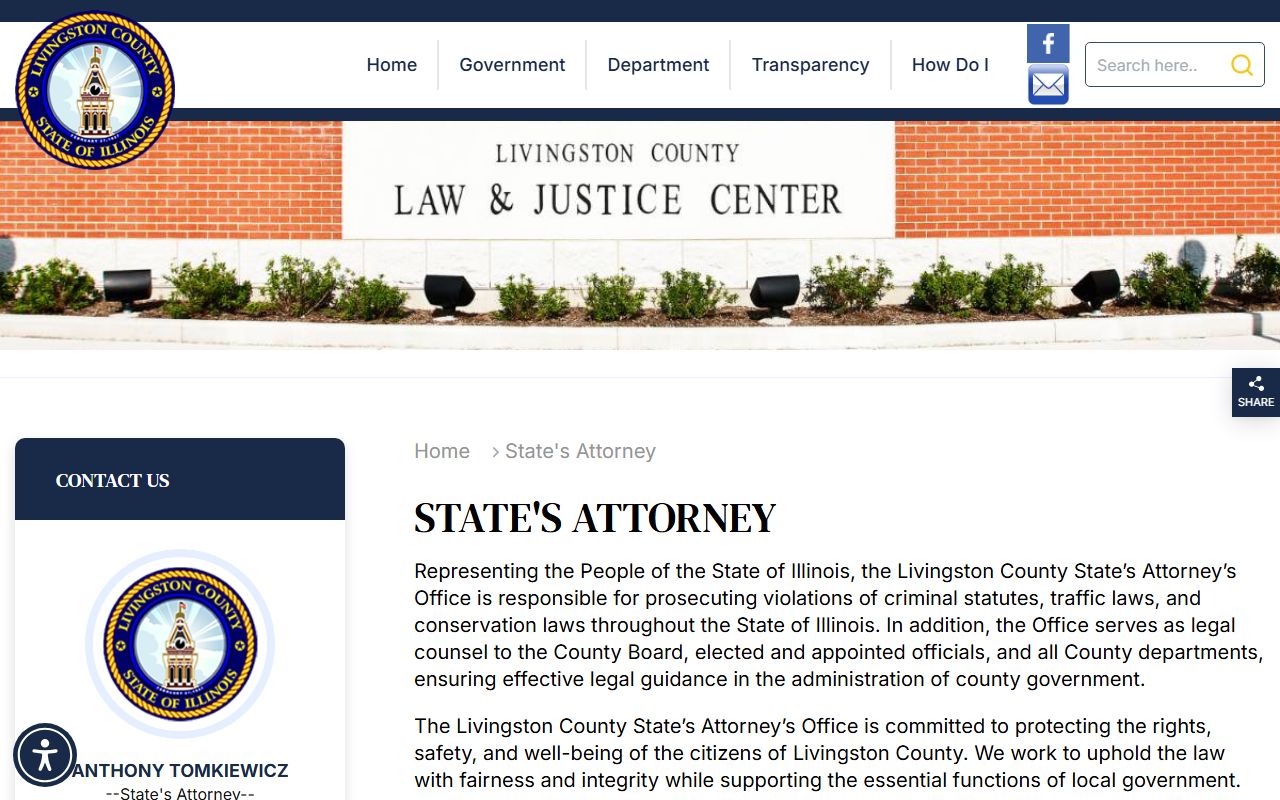
The office decides what to charge, so the booking charge at the jail is not always the charge that ends up in the court record.
Charge Status in the Court Record
Charges shift as a case moves. The prosecutor may amend, reduce, add, or drop a count, and a judge may dismiss one. That is why the charges in the court record after an arrest can differ from the charges listed at booking. The common status words are below.
| Status | What It Means |
|---|---|
| Pending | The charge is filed and the case is still open. |
| Amended or reduced | The charge was changed, often to a lesser offense. |
| Dismissed | The charge was dropped by the court. |
| Nolle prosequi | The prosecutor chose not to pursue the charge. |
Pretrial Release and Detention After an Arrest
Illinois no longer uses cash bail as the normal way to get out before trial. Under the state's pretrial law, release and detention are court decisions made after the arrest, not a fixed dollar amount paid at the jail. So do not assume every person has a cash bond. After booking, the court weighs release conditions, and the State's Attorney may ask the court to detain a person in eligible cases.
A few terms help make sense of the court record on this point.
- Pretrial release - the court lets a person go before trial, often with conditions.
- Conditions of release - rules such as appearing in court, no contact, or supervision.
- Detention - the court orders continued custody after a hearing when the law allows it.
- Hold or warrant - another case, agency, or jurisdiction can keep a person in custody even when one case allows release.
If a person stays in custody after a release order, the cause may be conditions, a separate hold, or a warrant from another court. The jail and the Circuit Clerk can help identify which.
Warrants That Lead to an Arrest
Many arrests start with a warrant. An arrest warrant follows a criminal complaint, and a bench warrant often follows a missed court date. Livingston County does not post a searchable warrant list online, so the safest check is through the court or the sheriff rather than a surprise appearance.
The Circuit Clerk can route court-issued warrant questions at 815-844-2602, and a case in Judici may show warrant-related events even when no public warrant list exists. The Sheriff's Office handles warrant arrests at 815-844-2774. A lawyer's advice before a surrender can prevent problems, and an out-of-county warrant is controlled by the court that issued it.
The warrant behind an arrest can take a few forms, and each affects the court record differently.
- Arrest warrant - issued on a criminal complaint or case.
- Bench warrant - often issued after a missed court date or a violation of a court order.
- Search warrant - authorizes a search and does not always lead to an arrest.
- Fugitive or out-of-county warrant - controlled by the issuing court, while the local record may show only the hold or transport.
Note: A jail hold is not always a county warrant, since it can come from another county, the state, the U.S. Marshals, or immigration authorities.
Charges vs. Convictions in Court Records
An arrest and a charge are accusations, not proof of guilt. A conviction comes only after a plea or a verdict. Court records after an arrest can show open charges that never become convictions, so the two should never be read as the same thing.
| Charge | Conviction | |
|---|---|---|
| Stage | Accusation | Verdict or plea |
| Burden of Proof | Probable cause | Beyond a reasonable doubt |
| Public Record | Yes | Yes |
Sealed vs. Expunged Court Records
Illinois law lets some people clear an arrest or court record after a dismissal or an eligible outcome. The state expungement and sealing law, 20 ILCS 2630/5.2, sets the rules. Sealing hides a record from most public view, while expungement treats it as if it never existed.
| Sealed | Expunged | |
|---|---|---|
| Visibility | Hidden from public view | Destroyed or treated as if it never existed |
| Law Enforcement | Limited access | Very limited access |
| Eligibility | Set by 20 ILCS 2630/5.2 | Set by 20 ILCS 2630/5.2 |
Sealing and expungement are court remedies, not a website delete button. A cleared case is handled through the court and the originating agency.
Where the County Court Records Live
The Circuit Clerk keeps the official court file for the 11th Judicial Circuit in Livingston County. The clerk records filings, collects fines and fees, and points the public to Judici for case detail. A certified copy of a court record comes from the clerk, not from the online portal, since Judici is a public lookup rather than a certified source.
The Circuit Clerk page explains what Judici can show and how to reach the office. The screenshot below is that official Circuit Clerk page.
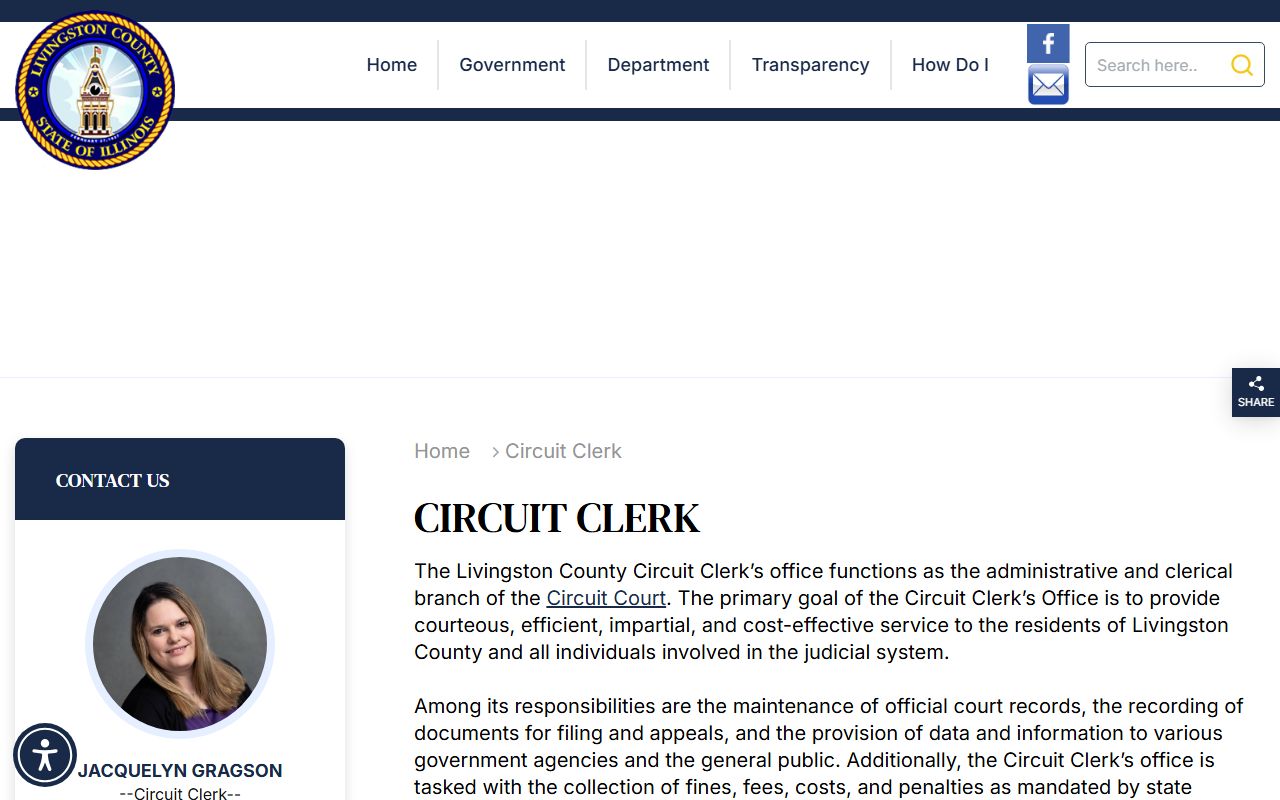
Because the judicial branch is exempt from the county open-records process, court records are requested from the clerk rather than the county FOIA officer.
Important: This site is not a consumer reporting agency, and its content cannot be used for credit, employment, tenant, or other FCRA-covered screening.
Restricted Court Records After an Arrest
Not every record after an arrest is open. Juvenile cases are protected, sealed and expunged charges are withheld, and details tied to an active investigation can be held back. Victim and witness information may be limited as well. When a record is restricted, the court applies the law rather than a clerk's choice, and the public copy may be redacted or unavailable.
A denial or a redaction does not always mean a record is missing. It can mean the law required the office to withhold part of it, or that the request did not include enough detail to match a case. When that happens, the Circuit Clerk can explain which route fits, and a sealing or expungement order is handled with the originating agency rather than the public portal.